

Navigating the Public Environmental Humanities
Published: 8 June 2026
What do we mean by engaging ‘publics’ in academic research? And how as environmental humanities doctoral researchers do we address this burgeoning field’s impact beyond the academy?
By Alice Barron-Eaves (University of Edinburgh), Anna Stacey (Queen Margaret University & University of Edinburgh), and Harriet Crisp (University of Stirling) — co-organisers of the workshop.
On the 14th May 2026, convenors of the Edinburgh Environmental Humanities Network (EEHN) PhD Lab hosted a full-day training event for PhD students to discuss and contemplate the nebulous questions above within their research at the Edinburgh Futures Institute, a fitting home for debating this intersectional and future-focused aspect of environmental humanities research. Inspired by a recent agenda-setting article (van Dooren et al., 2024), the event addressed the different ethical, methodological and epistemological challenges of navigating research design, execution and dissemination with different publics. The morning session comprised of presentations followed by a panel discussion with three of our invited academics: Dr Jo Vergunst (University of Aberdeen); Dr Rowan Gard (King’s College London); and Dr Jen Clarke (Gray’s School of Art), chaired by EEHN Convenor, Dr Zeynep Oguz. Each academic brought a unique perspective on publicly-engaged practice, highlighting the possibilities such approaches offer early career academics finding their feet in the field.
Dr Jo Vergunst delivered a session focused on his collaborative project ‘A Treescapes Curriculum: Activities for Learning with Local Trees and Woods’, an experimental toolkit designed to support children and young people within an outdoor environment. Dr Vergunst discussed the challenges and joys of engaging children and young people in an outdoor education setting, showcasing the inventive potentials for teaching and learning beyond the classroom. Dr Rowan Gard gave us a whirlwind tour of her copious research endeavours in the Pacific, notably in relation to Pacific Island communities facing significant problems posed by climate change and the role of local community activism in bringing awareness to these communities. Likewise, Dr Gard highlighted a recent collaborative project, ‘A Temple for Cassandra’, which illustrated the value of cross-disciplinary research in finding new methods for engaging with the classics. Dr Jen Clarke reflected on her artistic and anthropological engagements with ecological publics, offering the idea of turbidity as a way to reflexively attend to and image environments without reducing their complexity to representation. Clarke also posited that researchers produce publics through their engagements, a useful takeaway for PhD students struggling to find a pre-existing public to work with.
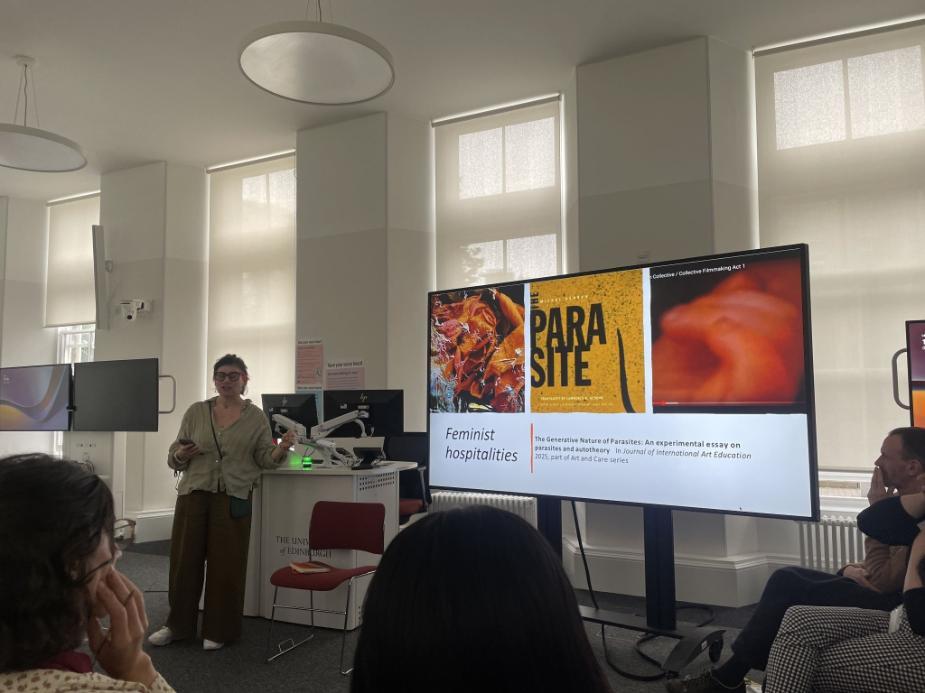
For the Q&A component of the session, Dr Oguz posed some questions curated by members of the EEHN PhD Lab that reflected the challenges and discussion points that regularly arise in our fortnightly meetings concerning publicly-engaged research. All three panellists offered insightful answers about navigating the challenges of accessibility when interacting with publics and how to deal with the short-termism of project funding and the knock-on effects this can have on meaningful and sustainable impact - a key talking point within the academy. Attendees were then invited to ask questions which sparked a fascinating discussion on contested land and the concept of counterpublics.
After lunch, the afternoon portion of the event offered a change of pace, where attendees were invited to join one of two workshops run in tandem: walking as a creative method with Dr Sonia Overall (Canterbury Christ Church University), or a discussion on activism and public engagement with Dr Michelle Bastian (University of Edinburgh). Dr Overall’s session was curated around her ‘walking scores box’ - a small wooden box containing dozens of pieces of paper the size of playing cards, each of which provided a prompt or intervention to consider whilst we walked around the nearby Meadows. We were invited to select a walking score at random and let the prompt guide our thoughts and perspective as we wrote in our notebooks. This session encouraged attendees to consider non-human publics and invite the landscape to become a participant in the research, to guide our senses and imagination. Dr Bastian’s session was a facilitated discussion about the role of activism in academic research, drawing on her own experiences participating in and conducting research with community sustainability initiatives in Liverpool. The discussion covered the ethics and scope of participatory research: working with over-researched communities, protecting the anonymity of research participants, advocating for marginalised or oppressed groups whilst within academia and navigating the extractive dynamics short-term project cycles can create. PhD students shared their own experiences of being both an activist and a researcher, discussing how to know when one takes precedence over the other, when these roles might merge and the complex responsibilities towards research participants this duality can introduce.
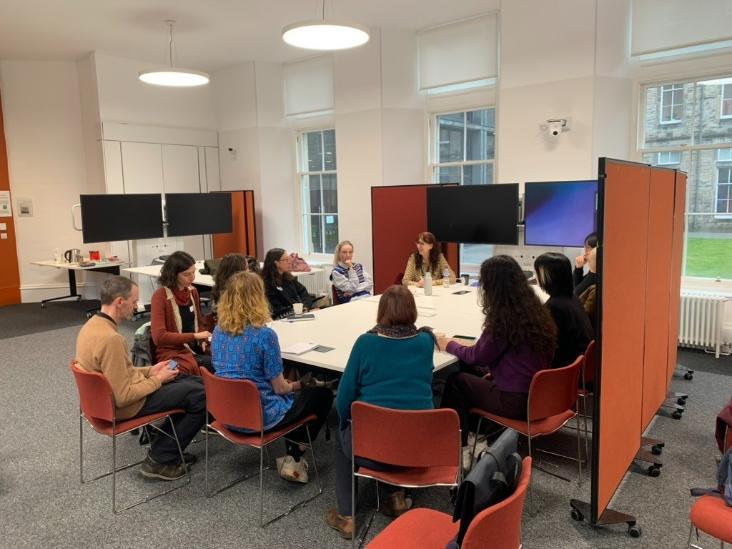
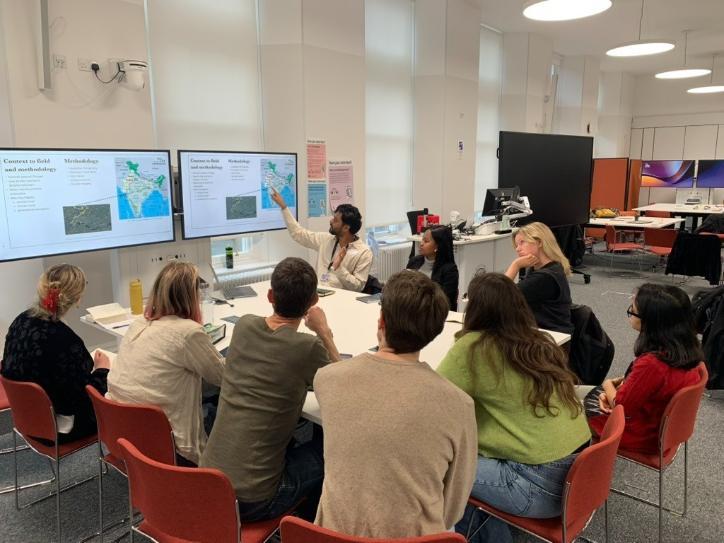
The afternoon continued in a similar format with two more workshops run alongside one another: writing with dirt by Dr Jane McKie (University of Edinburgh) and creative counter-mapping with Saurabh Hatkar (University of Edinburgh) and Emma Meehan (University of Edinburgh). In Dr McKie’s session the group got their hands dirty (metaphorically) pondering the question ‘what is dirt?’ through a series of writing prompts. In a similar fashion to Dr Overall’s session, attendees were encouraged to think beyond the human perspective and consider dirt, waste and its many associations from a more-than-human perspective. Saurabh and Emma’s session offered a varied exploration of counter-mapping as radical activism. Saurabh discussed his research with shepherd Dhanger, a pastoral community of Maharashtra, India, in which he is critically mapping oppressive state land management. Emma spoke about mapping in contemporary art, drawing on a number of works that use visual mapping to engage with energy politics. Attendees then drew inspiration from Saurabh and Emma’s presentations to create their own visual collage works using various maps of Scotland.
To round up the day we broke up into smaller groups each focused on three key ‘publics’ the organisers had identified as of interest to attendees: more-than-human publics, local and community-based publics, and policy and institutional publics. This session allowed attendees to come together with those working on similar research themes and queries and address existing challenges they are facing when engaging with their selected publics or to reflect on new ideas that had arisen from the day's activities.
In the evening we offered a group dinner, ensuring an informal way of connecting with fellow attendees outside of the conference-style format of the day. Ensuring accessibility to our event was paramount and we were conscious of the mental strain that intensive workdays can have on social batteries. As such, being able to offer a relaxed atmosphere to network proved successful and we were delighted that participants offered us warm feedback on the event.
First published: 8 June 2026